CJC-1295: Complete Research Guide
A synthetic analogue of Growth Hormone-Releasing Hormone (GHRH) with an extended half-life, studied for its ability to increase circulating growth hormone and IGF-1 levels.
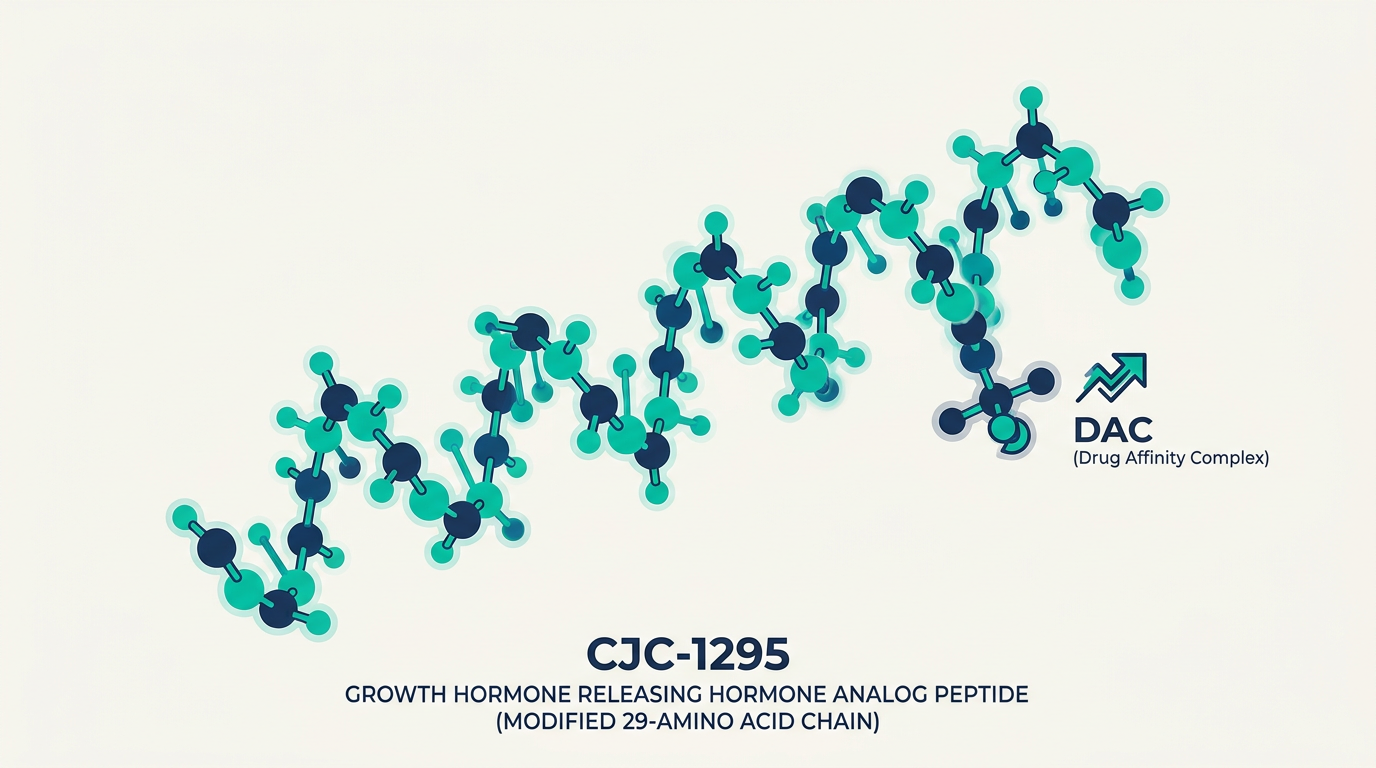
CJC-1295 is a synthetic peptide analogue of Growth Hormone-Releasing Hormone (GHRH). It is a research chemical investigated for its ability to increase circulating levels of growth hormone (GH) and insulin-like growth factor 1 (IGF-1). Developed in Canada by ConjuChem Biotechnologies, its primary purpose was to treat GH deficiencies and wasting syndromes.
The defining characteristic of CJC-1295 is its extended half-life compared to natural GHRH, which degrades in minutes. There are two primary forms used in research: CJC-1295 with Drug Affinity Complex (DAC), which has a very long half-life of about a week, and CJC-1295 without DAC (also known as Modified GRF 1-29), which has a half-life of about 30 minutes.
Due to its function as a powerful growth hormone secretagogue, it is often studied for its potential effects on body composition, muscle growth, fat loss, and tissue repair. Clinical development was halted, and it remains an unapproved, investigational substance.
What is CJC-1295?
CJC-1295 is a 30-amino acid peptide hormone analogue of GHRH. Natural GHRH is a peptide produced in the hypothalamus that stimulates the pituitary gland to release growth hormone. However, natural GHRH is very unstable and has a half-life of only a few minutes. CJC-1295 was designed to overcome this limitation.
The two variants have significantly different properties:
CJC-1295 without DAC (Modified GRF 1-29): This peptide is a truncated version of the first 29 amino acids of GHRH, with four specific amino acid substitutions that make it more stable than native GHRH. Despite this increased stability, its half-life is still approximately 30 minutes. This property allows it to produce a short, sharp pulse of GH release, more closely mimicking the body’s natural pulsatile pattern.
CJC-1295 with DAC: This version includes an additional lysine residue linked to a maleimidopropionyl group called the Drug Affinity Complex (DAC). The DAC component allows the peptide to form a covalent bond with albumin in the blood. This extends its half-life dramatically to approximately 6-8 days. A single injection can lead to a sustained elevation of GH and IGF-1 levels for nearly a week.
Mechanism of Action
Both forms of CJC-1295 function as growth hormone secretagogues. They bind to GHRH receptors on somatotroph cells in the anterior pituitary gland, mimicking endogenous GHRH and initiating a signaling cascade that results in the synthesis and pulsatile release of stored growth hormone.
The released GH then travels to the liver and other tissues, where it stimulates the production of Insulin-like Growth Factor 1 (IGF-1). IGF-1 is the primary mediator of most of GH’s anabolic and growth-promoting effects, including increased protein synthesis, enhanced cellular repair, and lipolysis (fat breakdown).
A key aspect is that CJC-1295 stimulates the body’s own pituitary gland to produce GH, which is different from administering exogenous synthetic GH. The release remains under the influence of the body’s natural feedback loops, including regulation by somatostatin.
The primary difference between the two forms lies in pharmacokinetics: • CJC-1295 without DAC provides a short, strong pulse of GH, similar to a natural GHRH spike. Its effects are transient. • CJC-1295 with DAC provides continuous, low-level stimulation resulting in a sustained elevation of baseline GH levels. Phase 1 clinical data showed that a single injection could increase GH levels 2- to 10-fold for at least six days and IGF-1 levels 1.5- to 3-fold for 9 to 11 days.
Research Applications
Research on CJC-1295 has focused on the potential benefits derived from elevated GH and IGF-1 levels.
- Increased Muscle Mass and Strength: By elevating GH and IGF-1, CJC-1295 is studied for its potential to increase protein synthesis and promote the growth of lean muscle tissue.
- Fat Loss: GH is a potent lipolytic agent. Studies investigate CJC-1295 for its ability to reduce body fat, particularly visceral adipose tissue.
- Improved Recovery and Tissue Repair: GH and IGF-1 are critical for tissue repair and regeneration. Research explores CJC-1295 to accelerate recovery from injuries.
- Enhanced Sleep Quality: Natural GH release is highest during deep, slow-wave sleep. Some research suggests CJC-1295 may promote deeper, more restorative sleep patterns.
- Increased Bone Density: GH plays a role in bone metabolism by stimulating osteoblast activity.
- Synergy with GHRPs: CJC-1295 without DAC is very frequently used in combination with a Growth Hormone Releasing Peptide like Ipamorelin. Stimulating both the GHRH receptor and the ghrelin receptor simultaneously has a powerful synergistic effect, leading to a much larger GH pulse than either peptide alone.
Dosage Protocols in Studies
Dosage protocols differ significantly between the two forms. All information is for research reference only.
CJC-1295 with DAC: • Frequency: Once or twice per week due to its long half-life • Dose Range: 1,000 mcg (1 mg) to 2,000 mcg (2 mg) per week • Cycle Length: 8 to 12 weeks, followed by 4-6 weeks off
CJC-1295 without DAC (Mod GRF 1-29): • Frequency: 2-3 times daily due to its short half-life • Dose Range: 100 mcg per injection • Timing: On an empty stomach — upon waking, post-workout, and before bed
Combination Protocol (with Ipamorelin): A standard synergistic protocol involves combining 100 mcg of CJC-1295 without DAC with 200-300 mcg of Ipamorelin in the same syringe, administered 2-3 times daily. Some protocols use a 5-days-on, 2-days-off weekly schedule.
Like other peptides, CJC-1295 is a lyophilized powder that must be reconstituted with bacteriostatic water and stored in a refrigerator (2-8°C).
Safety Profile & Considerations
Side effects are primarily related to the increase in GH and IGF-1 levels.
Commonly reported side effects include: • Injection site reactions (redness, pain, itching) • Water retention (edema), often noticed as puffiness in the hands and feet • Tingling or numbness in the extremities (paresthesia) • Temporary flushing sensation or warmth after injection • Headaches and mild joint pain • Fatigue or drowsiness
With CJC-1295 with DAC, these side effects can be prolonged, lasting for days after an injection due to the peptide’s long half-life.
A significant safety event occurred during a Phase 2 clinical trial in 2006 for HIV-associated lipodystrophy. A study participant died from a myocardial infarction (heart attack). Although the attending physician attributed the death to pre-existing coronary artery disease and deemed it unrelated to the study drug, ConjuChem discontinued development as a precaution.
Other considerations include the potential for increased insulin resistance with prolonged use and the theoretical risk of pituitary desensitization, especially with the long-acting DAC version.
Canadian Regulatory Context
CJC-1295 was originally developed by ConjuChem Biotechnologies, a Canadian company. Despite its Canadian origins, the compound is not approved for any medical use in Canada or elsewhere. Following the discontinuation of its clinical development in 2006, there is no active pathway for its approval by Health Canada or the FDA.
CJC-1295 is classified as a research chemical. Its sale and purchase are restricted to research purposes. The World Anti-Doping Agency (WADA) has banned all forms of CJC-1295 for use by athletes due to its potent ability to increase growth hormone levels. Its legal status is similar to that of other unapproved peptides: it cannot be sold as a supplement or therapeutic good.
Frequently Asked Questions
What is the main difference between CJC-1295 with DAC and without DAC?
The main difference is the half-life. CJC-1295 with DAC has a Drug Affinity Complex that extends its half-life to 6-8 days, allowing for weekly dosing but causing continuous GH elevation. CJC-1295 without DAC has a short half-life of about 30 minutes, requiring multiple daily injections to produce short, distinct pulses of GH release.
Why is CJC-1295 often combined with Ipamorelin in research?
CJC-1295 (without DAC) and Ipamorelin act on two different receptors in the pituitary gland. CJC-1295 activates the GHRH receptor, and Ipamorelin activates the ghrelin receptor. When used together, they create a synergistic effect producing a much larger GH pulse than either peptide alone.
Is CJC-1295 a form of synthetic growth hormone?
No. CJC-1295 is a GHRH analogue that stimulates the body’s own pituitary gland to produce and release its own GH. This is different from taking exogenous GH directly.
What happened to the clinical development of CJC-1295?
Phase 2 clinical trials for CJC-1295 with DAC were halted in 2006 after a participant in a study died of a heart attack. Although the death was not definitively linked to the drug, the company discontinued development as a precaution.
What are the most common side effects observed in CJC-1295 research?
The most common side effects are consequences of elevated growth hormone levels, including water retention, tingling in the hands and feet, joint pain, headaches, and injection site irritation.
Research Disclaimer
The information presented on this page is for educational and research purposes only. This content does not constitute medical advice, diagnosis, or treatment recommendations. The compounds discussed are investigational and, unless otherwise noted, have not been approved for human therapeutic use by Health Canada or any other regulatory body. Always consult a qualified healthcare professional before considering any new treatment or substance.
Looking for Research-Grade Peptides?
HCR Health provides high-purity, third-party tested research peptides for the Canadian market.
Browse Products at HCR Health