Ipamorelin: Complete Research Guide
A highly selective growth hormone secretagogue that stimulates pulsatile GH release without significantly affecting cortisol or prolactin levels.
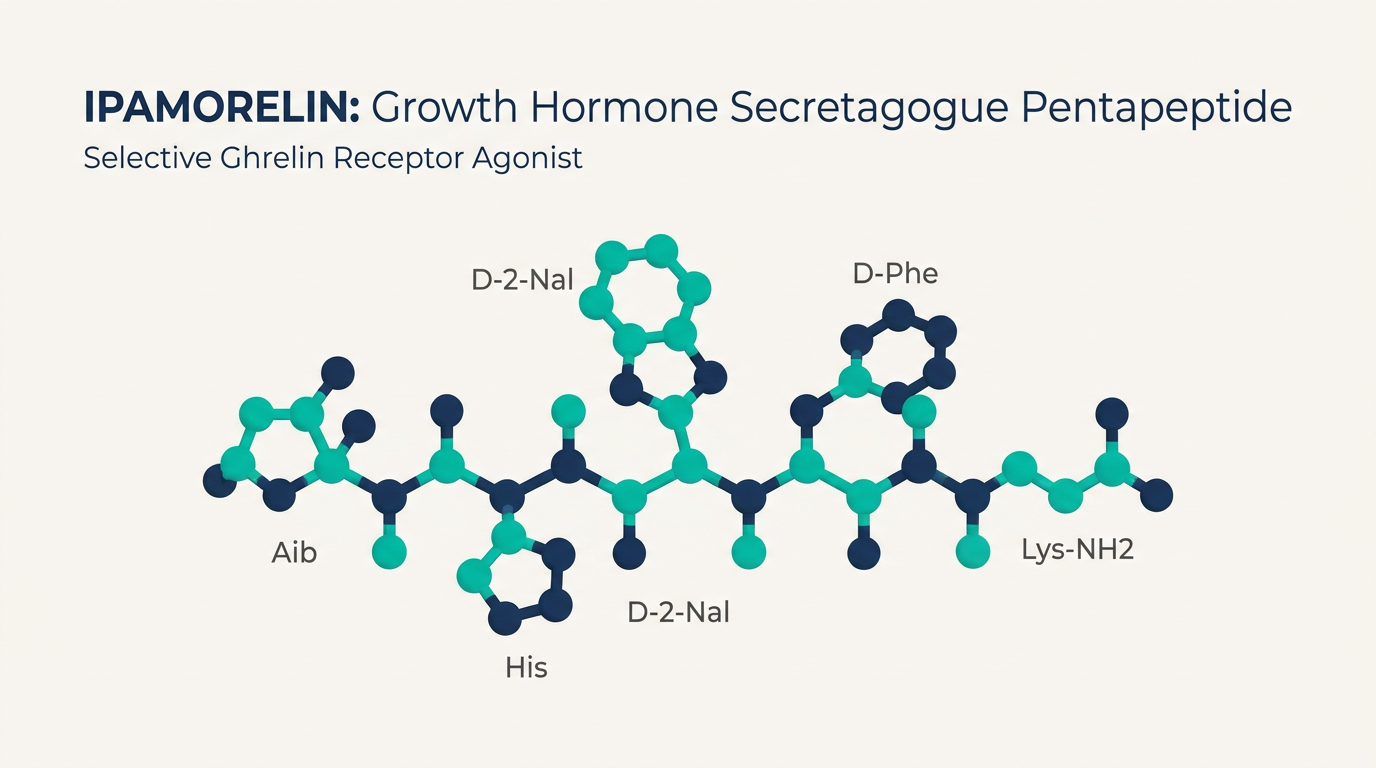
Ipamorelin is a synthetic pentapeptide classified as a growth hormone secretagogue (GHS). It is one of the more recent and highly selective compounds in the family of Growth Hormone Releasing Peptides (GHRPs).
Researchers study Ipamorelin for its ability to stimulate the pituitary gland to release endogenous growth hormone (GH) with high specificity. Its primary appeal in a research context is its capacity to induce a significant GH pulse without notably affecting other hormones like cortisol, prolactin, or adrenocorticotropic hormone (ACTH), thereby minimizing certain undesirable side effects associated with older secretagogues.
It is investigated for potential applications in increasing lean body mass, promoting fat loss, improving sleep quality, and enhancing tissue repair. Ipamorelin remains an investigational drug, has not been approved for therapeutic use, and is banned in competitive sports.
What is Ipamorelin?
Ipamorelin is a synthetic peptide with the amino acid sequence Aib-His-D-2-Nal-D-Phe-Lys-NH2. It was designed to be a potent and highly selective agonist for the ghrelin/growth hormone secretagogue receptor (GHSR-1a). This receptor is the same one that is naturally activated by ghrelin, the “hunger hormone,” which, in addition to stimulating appetite, also potently stimulates GH release.
Ipamorelin is considered a third-generation GHRP. Unlike its predecessors, such as GHRP-6 and GHRP-2, which can cause significant increases in appetite and elevations in cortisol and prolactin, Ipamorelin’s design provides a cleaner, more targeted stimulation of GH release. This selectivity is its defining characteristic and makes it a valuable tool for researchers studying the effects of pulsatile GH elevation in isolation.
Pharmacokinetically, Ipamorelin has a relatively short plasma half-life of approximately two hours. This means it is absorbed and cleared from the body fairly quickly, useful for creating distinct, timed pulses of GH that mimic the body’s natural circadian rhythm of GH secretion.
Mechanism of Action
Ipamorelin exerts its effects by binding to and activating the GHSR-1a receptor, primarily located on somatotroph cells in the anterior pituitary gland.
Activation of the GHSR-1a receptor initiates a downstream intracellular signaling cascade involving an increase in cyclic adenosine monophosphate (cAMP) and subsequent activation of protein kinase A (PKA). This ultimately leads to the release of stored growth hormone from the pituitary into the bloodstream.
Ipamorelin’s action is twofold: • It directly stimulates GH release from the pituitary gland. • It suppresses somatostatin, a hormone that acts as the body’s natural “brake” on GH release. By temporarily inhibiting somatostatin, Ipamorelin allows for a larger and more robust GH pulse.
A crucial feature is its selectivity. Even at high doses in research settings, it does not appear to significantly stimulate the release of other pituitary hormones like ACTH, prolactin, FSH, LH, or TSH. This high degree of specificity minimizes the potential for side effects related to stress hormone elevation.
When combined with a GHRH analogue like CJC-1295 without DAC, Ipamorelin’s effect is amplified. The GHRH analogue “primes” the somatotrophs while Ipamorelin activates the GHSR-1a pathway and removes the somatostatin “brake.” This produces a powerful, synergistic GH release far greater than either peptide alone.
Research Applications
The potential applications of Ipamorelin are all linked to elevated pulsatile growth hormone and the subsequent increase in IGF-1.
- Increased Lean Muscle Mass: Ipamorelin is investigated for its potential to stimulate protein synthesis and reduce protein breakdown, leading to increased lean muscle mass and improved muscle strength.
- Enhanced Fat Loss (Lipolysis): GH stimulates the breakdown of stored fat in adipose tissue. Research explores Ipamorelin’s ability to reduce fat mass, particularly visceral belly fat.
- Improved Sleep Quality: The body’s largest natural pulse of GH occurs during early deep sleep. Nighttime administration of Ipamorelin is studied for its potential to enhance sleep architecture and promote deeper, more restorative sleep.
- Tissue Repair and Recovery: GH and IGF-1 are fundamental to cellular repair. Ipamorelin is studied for its capacity to accelerate healing from injuries and support tissue rebuilding.
- Bone Health: GH plays a role in regulating bone turnover, and research suggests potential benefits for bone mineral density through stimulation of osteoblast activity.
- Anti-aging Effects: Many signs of aging are associated with the natural decline in GH production (somatopause). Research investigates Ipamorelin as a means to restore more youthful GH patterns.
Dosage Protocols in Studies
Ipamorelin is an investigational compound without regulator-approved dosing schedules.
- Administration Route: Typically via subcutaneous injection.
- Dosage Range: 100 to 300 mcg per injection.
- Frequency and Timing: 1 to 3 times per day. For general wellness or anti-aging research, a single injection of 200-300 mcg at bedtime is common. For muscle growth, additional injections upon waking and post-workout may be used.
Combination Protocol: A standard synergistic protocol involves combining 200-300 mcg of Ipamorelin with 100 mcg of CJC-1295 without DAC in a single injection, administered once or twice daily, typically at night.
Cycle Structure: To prevent receptor desensitization, research cycles often follow a pattern such as 5 days on, 2 days off, or run for 8-12 weeks followed by a 4-week break.
To maximize the GH pulse, doses should be administered on an empty stomach or at least 2 hours after a meal, as insulin and circulating fatty acids can blunt GH release.
Safety Profile & Considerations
Compared to other growth hormone secretagogues, Ipamorelin is generally considered to have a favourable safety profile due to its high selectivity.
Potential side effects include: • Injection site reactions (mild pain, redness, or swelling) • Headaches, often transient and occurring in the first few days • A feeling of lightheadedness or a “head rush” after injection • Mild water retention or joint stiffness • Tingling sensations in the hands or feet (paresthesia) • A slight increase in appetite (much less than with GHRP-6)
Contraindications include: • Active Cancer: GH and IGF-1 can promote cell growth. Ipamorelin is contraindicated in individuals with active malignancy or a history of hormone-sensitive cancers. • Metabolic Effects: Repeated large GH pulses can affect glucose metabolism and insulin sensitivity. • Pregnancy and Breastfeeding: Safety has not been established. • Pituitary Disorders: Contraindicated in individuals with known pituitary tumours.
Long-term safety data in humans is limited. Sustained elevation of IGF-1 levels above the normal range is generally considered undesirable.
Canadian Regulatory Context
Ipamorelin is not approved for any therapeutic use by Health Canada, the U.S. FDA, or any other major regulatory agency. Its legal status in Canada is that of an investigational new drug or research chemical. It can be legally sold for laboratory research purposes but cannot be marketed, sold, or prescribed for human use.
The World Anti-Doping Agency (WADA) has placed Ipamorelin on its Prohibited List under section S2, “Peptide Hormones, Growth Factors, Related Substances and Mimetics.” Its use by athletes in tested sports is banned at all times.
The availability of Ipamorelin through compounding pharmacies or online research suppliers does not imply regulatory approval or oversight of product quality and safety.
Frequently Asked Questions
What makes Ipamorelin different from other GHRPs like GHRP-2 or GHRP-6?
Ipamorelin’s key difference is its high selectivity. While all three stimulate GH release by acting on the ghrelin receptor, GHRP-6 and GHRP-2 can also cause significant increases in appetite and stimulate cortisol and prolactin release. Ipamorelin stimulates GH without significantly affecting these other hormones.
Why is Ipamorelin administered at night in many research protocols?
The body’s largest natural GH pulse occurs during the first few hours of deep sleep. Administering Ipamorelin before bedtime is intended to mimic and amplify this natural rhythm, maximizing its restorative benefits.
Can Ipamorelin be taken orally?
No, Ipamorelin is a peptide and would be broken down by digestive enzymes in the stomach if taken orally. It must be administered via injection, typically subcutaneously.
Is Ipamorelin safe for long-term use?
The long-term safety of Ipamorelin in humans has not been established. There are no large-scale, long-duration clinical trials. While it appears well-tolerated in short-term research, the potential consequences of chronically elevating GH/IGF-1 levels are not fully understood.
Does Ipamorelin shut down the body’s natural GH production?
No, because Ipamorelin is a secretagogue that works by stimulating the pituitary gland to release its own GH. The pituitary gland remains functional. Cycling protocols are often used to help prevent receptor downregulation.
Research Disclaimer
The information presented on this page is for educational and research purposes only. This content does not constitute medical advice, diagnosis, or treatment recommendations. The compounds discussed are investigational and, unless otherwise noted, have not been approved for human therapeutic use by Health Canada or any other regulatory body. Always consult a qualified healthcare professional before considering any new treatment or substance.
Looking for Research-Grade Peptides?
HCR Health provides high-purity, third-party tested research peptides for the Canadian market.
Browse Products at HCR Health